A Day In the Life

Lessons I Learned From Art on a Cart

During SOL testing, I spent three weeks as “art on a cart.” I was aware going into it to it that it would be challenging, but also temporary, and I knew that I could make it work*.  During my brief time on a cart, I learned some useful lessons.

Keep the mediums to a minimum. I knew that the only way I could survive having limited access to my room and my supplies, meaning no restocking the cart during the day, was to limit the different mediums I used. Thankfully, I planned ahead and timed stitching and weaving to occur during SOL testing. My first three classes worked on stitching and weaving, and my lasartcartt two classes of the day worked on various different paper strip projects. With careful planning and a well organized cart, I was able to have all of the supplies I needed for the entire day on one cart. This definitely wouldn’t have been possible had I been using multiple mediums throughout the day.

Do not assume students will have basic supplies in their classrooms. I made a point of checking with classroom teachers to see what kind of basic supplies students had in their desks (pencils, crayons, scissors). Thankfully it worked out that students already had these supplies, so I didn’t have to worry about hauling them to the classroom myself, but I’m sure it’s not always the case in every classroom, especially at this time of year. Unfortunately, I neglected to think of myself, and was left scrambling for basic supplies while demonstrating the project to students. Evidently, not all teachers keep a small bin of Sharpies, pencils, a pair of scissors, a ruler, crayons and a glue stick on hand for demonstrations. Who knew?

My house, my rules. I have done a lot of subbing in my time. When a sub is present, many students have the knee-jerk reaction of who are you to tell me what to do? Feathers can get ruffled, chaos can ensue. It’s expected when you’re a sub. You’re on their turf, there’s going to be a bit of a power struggle. I did not expect this to happen while on a cart, but it did. I naively thought I could seamlessly carry my art room rules into the students’ classroom. I was wrong. Like art teachers, classroom teachers work hard to build routines. They have their own rules (or lack thereof). Students learn, in this room, we do things this way. In one particular classroom, I found that the classroom teachers’ rules were a little more loosey goosey than mine. All of a sudden I have students getting up to get drinks or use the bathroom without permission, “but, Mrs. Carter** let’s us…” I found it difficult to establish authority in another teacher’s room, although I already had it in my classroom. It was especially difficult if the teacher remained in the room during art. It was an unexpected challenge.

A change of scenery can do you good. The above scenario wasn’t the norm for my experience on a cart. I was fortunate to have access to the SACC room during testing. The unfamiliar location worked to my advantage. You know how at the start of the school year, the students are a little timid, unsure, and on their best behavior for the first few weeks? The same happened while we were in the SACC room. It was fabulous. The change of scenery was exactly what we needed to reset some of the bad behaviors/habits that had developed (theirs and mine) throughout the year in my art room.

If you pile it high enough, it will fall. A stack of 12 x 18″ paper on top of a bin of Play-doh on top of three bins of paper strips and scissors on top of 30 paper weavings on top of two boxes of stitcherys on top of a dish rack of cardboard loom weavings*** on top of a rolling art cart equals disaster. Lesson learned.

Art on a cart = sympathy. I’ve never received more sympathetic looks from other teachers than when I was wheeling my towering art cart through the halls. Okay, maybe when I was seven months pregnant in the sweltering 90 degree temperatures of June, waddling all the way across the school with a cart of clay animals to put in the kiln, but still, being temporarily demoted to art on a cart will garner looks of sympathy from others.

Kids are flexible. I was afraid that I would be disadvantaged by my lack of supplies while on a cart. Especially when I thought of those two dreaded words every art teacher hates to hear, “I’m finished.” In my art room, students have a variety of supplies and activities available to them when they finish early. In my art room, they were used to having multiple options for adding color to their work, crayons, markers, colored pencils, oil pastels… While on a cart, early finishers had one choice, free draw with crayons. That’s it. I was fully prepared for a mutiny, but the uprising never happened. Turns out, when you tell students that this is what you can work on, and they see that there are no other options available, they’re totally okay with that. Really makes me wish I didn’t have open shelving in my art room as my only storage option.

Art on a cart isn’t the end of the world. I survived art on a cart for three weeks. Would I want to do it for an entire year? Probably not, but it wouldn’t be the worst teaching scenario I’ve been in over the years (that honor goes to the two years I was in a windowless, ventless, octagonal room with less usable square footage than the living room in my townhouse). I could certainly make art on a cart work. Don’t tell my principal I said that.


* I use this phrase multiple times during the school day. My students don’t really get it. Proof that I watch too much Project Runway?

** Name has been changed.

*** Just before my art on a cart experience, I discovered a few dish racks in our supply closet. I was pleased to discover that the cardboard looms I use slide (almost) perfectly into the drying racks. It makes storing the weavings much easier and neater. I place a small label on the lefthand corner of the looms where the students write their names. Then we “file” them on the racks, and they can easily pick their work out. You can see the racks in the picture above.
Standard
Gripes

5 Annoying Things Parents Say and Do At Art Shows

We had our pyramid art show last week. One of two I’m participating in this year. Maybe. If I get my act together for the second one. For those of you who are unfamiliar with “pyramids,” as I was up until about 5 years ago, here’s how it works. I work for a county wide school system. Within the county, we have regions. Within the regions, we have pyramids. Each pyramid consists of a high school, a couple of middle schools, and a handful of elementary schools. In our county, we have annual pyramid art shows (not individual school art shows as I was familiar with in the past). The shows are usually held at the pyramid’s high school. Get it?

But none of that is really relevant to this post, except that it will help you to understand the context of the content below. Regardless of the details of the art show, all art shows have one thing in common. Parents.

5 Annoying Things Parents Say and Do At Art Shows


1. “My daughter has had a piece of work in this show for the past three years. I don’t know why you didn’t choose her this year.”

Yes, but, your son has work on display, which is why you’re here, right? So…

2. “Do you work here?”

Hmmm… I’m sorry, what? As in, do I work here at this school, or do I work here at the show, which doesn’t really make sense, because none of us are really working right now, I mean, we’re not actually getting paid for this… Are you wondering if I’m a teacher, or a volunteer, or maybe you think I’m a high school student (yes, even at my advanced age, it still happens)? Did you not see my special art teacher t-shirt, or my school employee badge? What exactly is it that you want to know? Ohhhh! You need help. Well, sure, I’d be happy to help you. First off, “Do you work here?” is not a very polite way to approach someone. Why don’t you try this thing called common courtesy and start with an, “Excuse me,” because, believe it or not, I was actually engaged in a conversation with my colleague here. Next, try a “Can you help me?” That way, I know whether you’re looking for directions to the bathroom or you’re going to complain about the ridiculous way the show is set up before I admit to “working” here. Or not, depending on where you’re headed with this. What? You didn’t find that helpful? Oh, fine, the bathroom is around the corner on your left.

3. “But how come she has a 3 in art?”

Thank you for coming out tonight. You must be so proud to see your daughter’s work in the show. She worked really hard on this particular piece, and I wanted to acknowledge her effort here tonight. If you have any questions about her grade, you can email me or set up an appointment to meet with me. Now, if you’ll excuse me, this man needs help finding the cafeteria.

4. “I’m not surprised you picked my child’s work for the show. You should see the stuff he makes at home. Everyone in our family thinks his spin art is great”

I’m sure they do.

5. “I can just move this over here, right?”

Of course you can! I’m so sorry we placed that other artwork so close to your child’s artwork. Please feel free to move it out of the way so you can get the perfect picture. I would hate to have some other child’s work clutter up your photo. Would you like me to adjust the lighting for you too?

What annoying things do parents say or do at your art shows?
Standard
In the Art Room

Kiln Nightmare Update: Facts and Theories

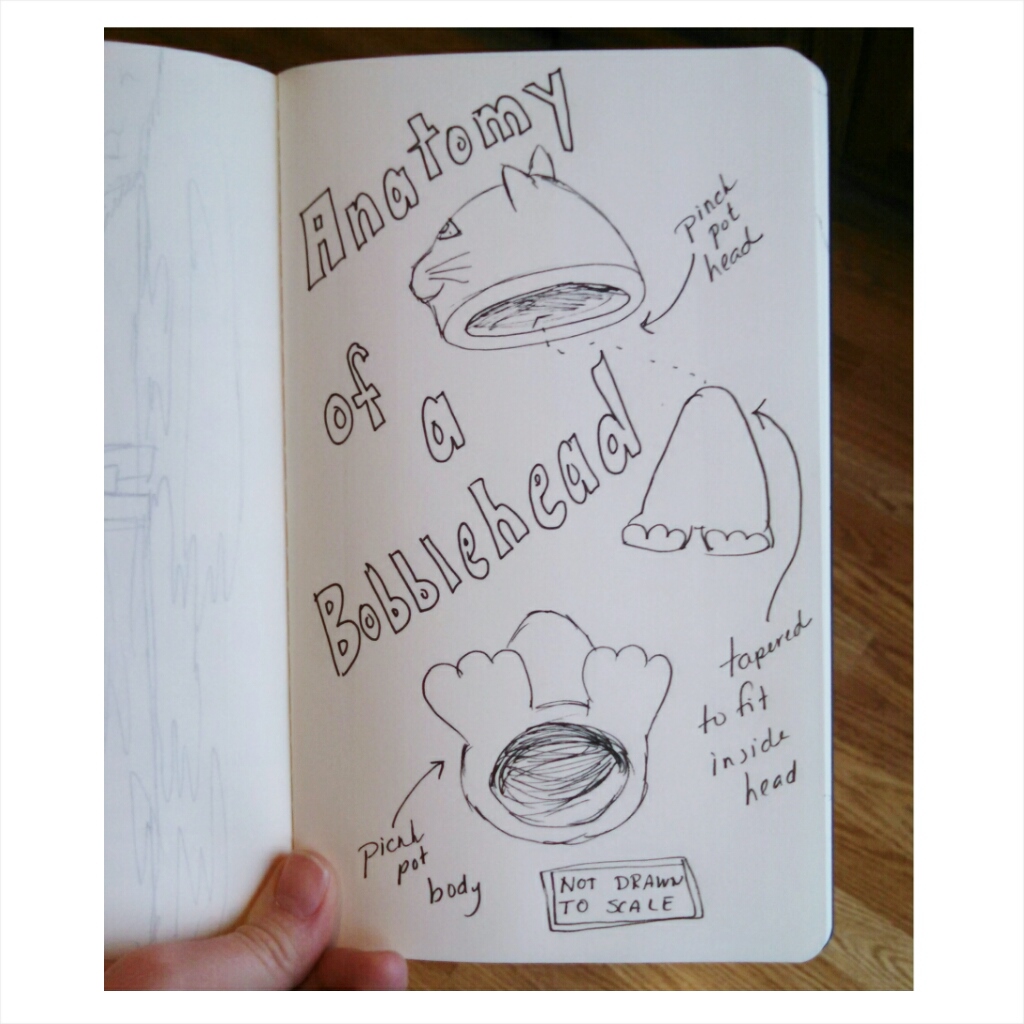
 PhotoGrid_1428067578224I feel like the mom who, in a search of solidarity, posted a statement about her child not sleeping through the night, and in return received a lot of unsolicited advice and responses about what she was doing wrong.

Yesterday I posted a pic of a kiln disaster. It happens. Maybe not to everyone, and good for you, but nonetheless, it happens to the best of us. I imagine it happens to the worst of us as well. Well, my Facebook page has been blowing up with advice and suggestions, and while I know your intentions are good, I can’t help but think you all believe me to be incompetent. I know, I know, that wasn’t your intention, but still…

The truth is, we can sit here and debate all day and night about what went wrong, but ultimately, we will never know. Why? Because we cannot replicate the conditions and test our theories. And there are a lot of theories. Before we look at my theories, let’s take a look at some facts:

Fact 1: 10 out of 26 bobbleheads survived in their entirety.

Fact 2: One of the bobbleheads that did not survive was my own sample.

Fact 3: All of the heads survived.

Fact 4: We have had problems with our electric kiln’s programming in the past, resulting in misfiring.

I have developed a few theories based on my experience and what I know about this particular situation.

Theory 1: The clay pieces were not dry enough.

This is my leading theory for what went wrong. I give my thicker pieces about two weeks to dry out, sometimes more. I don’t allow my students to make their pieces any thicker than two fingers (their fingers). I check the thickness of all pieces while they’re working. With thin slab pieces, I give them about a week. I’ve been doing this for years, and I haven’t had any problems. Except for this one time. So what makes this time different? I think it was where I let the pieces dry. Usually, all finished clay pieces are placed on shelves in the kiln room to dry. This time around, I left them in my classroom. Not only did I leave them in my classroom to dry, I left them in a plastic container. A plastic container with no lid, but a plastic container nonetheless. While the container was open and the pieces exposed to the air, I suspect that the container hindered air flow and didn’t allow the bottoms to dry thoroughly. I never do this, but this time I did. Why? Because the shelves in the kiln room were full? Because I didn’t feel like hauling them upstairs to the kiln room? Because I forgot about them? All of the above? I don’t know. If I could go back and ask myself, I would.

Theory 2: The kiln misfired.

This has happened in the past. Our kiln is electric and is preprogrammed. We have had the programs go wonky before and fire all elements at once and too quickly. I have had to reprogram the kiln before. I am aware that our kiln misfiring is always a possibility, and yet, when I fired the kiln that day, I did not check the program first. I should have, but I was in a hurry. I’m at this school one day a week, I had a lot to do that day, and I wanted to get the pieces in the kiln and fired. I was rushed. I was careless. I should have checked. On that particular day, I only stayed long enough to hear the kiln fire up and to take note of the lights to tell me it was firing. My memory is telling me that had I taken the time to really notice the lights, I would have seen that all three lights were lit, meaning all three elements were firing. I am now convinced that this is what happened and while it may not have caused the disaster, it certainly contributed to it. My visual memory has me seeing three lights. Maybe it’s lying to me. I don’t know. What I do know is that I’ll be reviewing the programs when I get back there next week.

Theory 3: Student error.

It’s possible they overworked the clay, creating small air bubbles. It’s possible they accidentally sealed up the bottom of their pinch pots. It’s possible, but not very likely, in my opinion.

I’ll never know what actually happened. I know that I made a couple of poor decisions that I don’t normally make that most likely contributed to the disaster. I made a couple of mistakes, and I am well aware of what they were. It can happen to anyone. Let’s move on now, okay?

For those of you wondering, my students took it pretty well. They were a little bummed at first, but I think it helped that all of the heads survived. The bodies are pretty easy to make, so I plan to remake the pinch pot bodies myself and have my students add the finishing touches (feet, details, textures). They were really cool about it. I’ll be sure to post a pic of the finished pieces.

Until then, thank you for your comments and advice, but really guys, I got this.

Standard
A Day In the Life

Nightmare in the Kiln

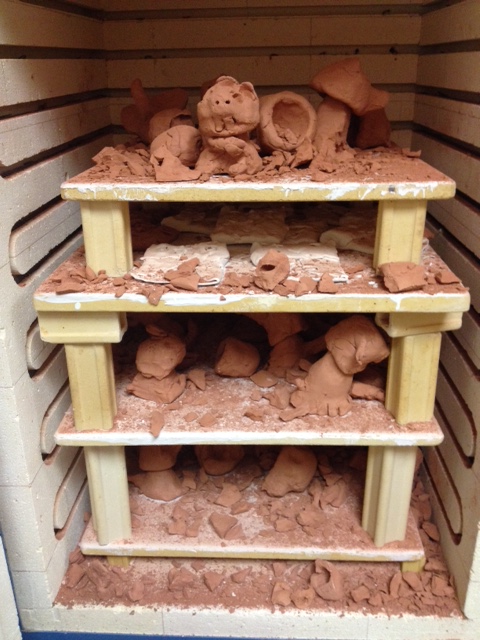
There’s a reason we all experience a little bit of fear every time we open a kiln of freshly fired bisqueware.

And this is that reason:

IMG_5394 (1)

Yeah, that’s a kiln full of 2nd grade animal bobble-heads.

I wasn’t present when the kiln was opened, but this picture was sent to me.

Devastating, to say the least.

Although I felt I had given them adequate time to dry out, it’s clear that I did not.

Amazingly enough, 10 out of 26 of the bobble-heads survived. My favorite is that little beaver up front, completely intact, innocently gnawing on his stick, oblivious to the carnage that lies behind him.

Even more amazing, every single head survived. Every. Single. One.

Like I tell my students, every time we work with clay, you never know. You just never know.

Standard
In the Art Room

“I don’t have time to make art.”

Bullshit.

Okay, let’s back up for a minute. Last November I made some confessions, one of which was, “I haven’t made art for myself since college.” Then I went on to whine and complain about how I don’t have any time and blah, blah, blah, wah, wah, wah. I received some support, but one individual’s comment really struck me:

NO excuses!!! You have to make time to make art, or you’re no longer an artist. I have been teaching elementary art for 24 years and I have always made art!…

After reading that, I was all, “F* you, Bob. You don’t know me. Who are you to say that to me?” Slow down. Without going into the debate of whether or not art teachers need to be artists, let’s focus on the other part of his comment, the time part. Here I am thinking, “I don’t have time for art anymore,” but the reality is, I do. I just need to change my idea of what art is (and dear god, please don’t anyone try to define what art is or what real art, or good art is to me in the comments. I heard enough of that elitist nonsense in grad school).

The thing is, I’ve always thought of art as something grand and meaningful. Something you would be proud to display on your wall, or a relative’s wall, or even, a stranger’s wall. This idea of art, most assuredly an idea implanted during my college days, has held me back. I don’t have time to paint a large scale oil painting, or the supplies for real printmaking (think metal plates and acid baths), or the space to set up my wheel and kiln, therefore, I do not have time to make art. I am no longer an artist.

Like many of us, creativity has always been a necessary outlet in my life. If I’m not able to create, in some manner or another, then I tend to lose my shit. True story. Creating centers me, calms me, and balances me. Creating is my therapy, as it is for many of us. Lately, I’ve been feeling frustrated because I “just don’t have the time to create.” My anxiety increases, my stress levels skyrocket, and my emotions bounce all over the place. It’s not pretty. Then, somewhere (I wish I could remember where), I stumbled upon a book, Art Before Breakfast: A Zillion Ways to Be Creative No Matter How Busy You Are by Danny Gregory. I literally received it yesterday (although it feels like I ordered it months ago). Not 15 pages into it, I had an epiphany. You see, I have had time for art. I have been creating art. It’s just, I haven’t been creating “Art,” with a capital ‘A’. In his book, or more specifically, on pages 14-15, Danny G. examines the idea of Art vs. art. In short, “Art” is for the pretentious, and “art” is the stuff we should be doing everyday, the doodles, the sketches, the cartoons.

Long story short (“Too late!”*), Danny G. presents a challenge to commit to doing something creative every day, for 30 days. It can be something as simple as drawing your breakfast. Well, Danny G., challenge accepted.

So here’s the deal. I’m on instagram now. You can find me by clicking on that little icon under my profile picture at the top of this page, or just follow this link: athglitter. I’m going to be posting pictures of my 30 day challenge, and if you want to join me, please do. Make sure you tag me in your post, @athglitter, and include the hashtags #artbeforebreakfast and #athglitter. Let’s encourage each other to  create!

Are you in?


* I’m a HUGE Clue fan. I’ve seen it a gazillion times. Well, at least half a gazillion, and it’s probably the only movie that I actually know any quotes from. That and maybe Spaceballs (“They’ve gone plaid!”). Anyway, if you know the movie, you get this reference. If you don’t, then go watch it, and then you’ll get it.

Standard