A Day In the Life

Nightmare in the Kiln

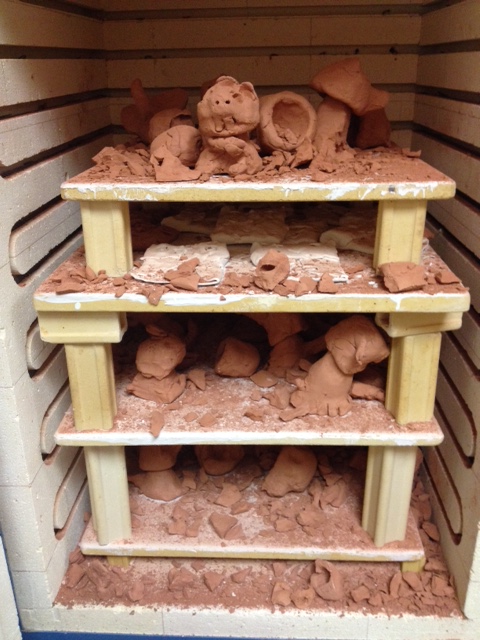
There’s a reason we all experience a little bit of fear every time we open a kiln of freshly fired bisqueware.

And this is that reason:

IMG_5394 (1)

Yeah, that’s a kiln full of 2nd grade animal bobble-heads.

I wasn’t present when the kiln was opened, but this picture was sent to me.

Devastating, to say the least.

Although I felt I had given them adequate time to dry out, it’s clear that I did not.

Amazingly enough, 10 out of 26 of the bobble-heads survived. My favorite is that little beaver up front, completely intact, innocently gnawing on his stick, oblivious to the carnage that lies behind him.

Even more amazing, every single head survived. Every. Single. One.

Like I tell my students, every time we work with clay, you never know. You just never know.

Standard
Small Scraps

Small Scraps: Frustrations, Funnies, & Fabulous Praise

“But what if we don’t want to do that?”

I had a 3rd grader ask me this absurd question after I introduced a lesson the other day. As in, I don’t want to do this lesson, what else do you have lined up for me? I can’t tell you how many times I have students ask me versions of this question. Since when did it become optional to do the lesson the teacher is teaching?


I have a particular 2nd grade class that always argues over who is at the end of the line. It’s usually the same three students. It doesn’t matter where I place them in line or how I call them to line up, the moment my back is turned, these students are at the end of the line, pushing and arguing over who gets to be at the end. Finally, determined to resolve the problem once and for all, I asked the classroom teacher if she has a specific line “ender”, my intention, of course, was to be able to say, “so-and-so is the line ender, problem solved.” The teacher replied to me, “We do… it changes every week… I don’t know who it is this week… I guess I could check…” So, you have classroom jobs but don’t actually check to make sure they are being done? Actually, that explains a lot. I now understand why I have so many difficulties with your class. Thank you.


The other day, while my 4th graders were working on coil pots, one girl came up to me for help and complained that working with clay was ruining her manicure. Her friend responded, “Well, you know we have art on Tuesdays, you should have waited.” Meanwhile, I’m thinking, “For real? You’re 9! Maybe 10. What are you doing getting professional manicures? Go get dirty. You have plenty of time to worry about your nails when you’re a teenager.” I’ve never had a manicure. Why? Because I work with clay and paint on a daily basis. Shortly after we convinced pretty-nail-girl to work the clay herself, the friend asked me, “why did you decide to become an art teacher?” “Because I like to work with my hands and get dirty,” I replied. Pretty-nail-girl sneered a little.


We give 6th grade assessments in our county. All students participate, and then we’re asked to submit a random sampling of the work (chosen by someone else). We’re not allowed to assist the students with their work, so you can imagine the range of work that gets done. At the end of the assessment, I watch as students turn in their projects, and I often cringe and think, “Ooh, I hope they don’t pick yours. Were you not even listening to the requirements?” And every year, without fail, the students who were the least successful are the students who are randomly selected. It pains me to send in their work when I know that there are so many stronger pieces that could have been chosen. So. Many.

The work is then scored and the data is used to assess… something. I’m not really sure of the details. I just know that the data is used for something. They used to score each school and each teacher based on these assessments, but they stopped doing that. Thank goodness, but that doesn’t stop me from feeling embarrassed when I submit photos of the poorly crafted work. I want to amend my submission with, “But wait! Look at all this good work that was made. Wouldn’t you rather assess this?” Welcome to the state of education today.


Lately, I find that bad behavior is being brushed off and explained away with excuses (by classroom teachers and administration alike). “Well, we’ve been having a lot of snow days lately, so you should expect the students to be off.” “Well, keep in mind it’s the week before break, so you should understand that the classes are going to be squirrely.” Well, this is our (1st)(2nd)(3rd) full week of school since (snow days)(break) so you can imagine the students are struggling.”

Whatever happened to accountability? If you keep explaining away bad behavior, when do students actually learn how to behave? If we don’t hold them accountable for their behavior, ever, why would they choose to behave? It’s getting pretty aggravating.


A 2nd grade class was cleaning up, and one girl noticed that there wasn’t much work for the Floor Cleaners to do since there wasn’t any mess. She explained, “it’s not like someone gave birth under the table.” Huh? Say what now? Okay then…


I was talking to my art teacher cohort’s long term substitute today. She’s subbed long-term for me in the past, as well as for other art teachers, even though it isn’t her field. Today she kept going on about how much work is involved in teaching art (not in a complaining way, but in an understanding, sympathetic way). She compared it to what regular classroom teachers do, “anyone can photocopy a math worksheet, but what you art teachers have to do for prep is unbelievable, and physical, all the lifting, bending, paper cutting… there’s so much prep work involved.” She’s great, for so many reasons, and we always appreciate the extra mile she goes for us. I sometimes wish we could get regular classroom teachers or administration to fill-in for us for a week. What an eye opener that would be, am I right?

Standard
A Day In the Life

It’s an art room. Get over it.

“It smells weird in here. It smells like paint in here. Why does it smell in here? There’s paint on the floor. There’s paint on the table. There’s paint on my paper. There’s paint on my chair. My shirt has paint on it. My hands have paint on them. My hands are dirty. There’s clay on my hands. There’s clay on the table. There’s clay on the floor. There’s clay in my fingernails. There’s glue on my fingers. There’s glue on the table. My table’s wet. There’s water on my paper. There’s water on the floor. I found a crayon on the floor. I found a marker in the colored pencil bin. The pencil sharpener is noisy. It’s too loud in here. It’s cold in here. It’s hot in here.”

Every. Single. Day.


If you haven’t heard, Art Teachers Hate Glitter has been nominated as Wild Card Blog of the Year over at The Art of Education. If you get a moment, it sure would mean a lot to my ego if you could hop on over there and vote for ATHG. Voting continues until Friday, January 23rd. Thank you.
Standard
In the Art Room

Things Were Going So Well, Until…

dogsruleIt was clay day, and we had just finished making leaf dishes. The classroom was cleaned up, and the students were quiet. There were fifteen minutes left in class. After schooling the first graders on the workings of the kiln and the different states of water, having really grabbed their attention when I mentioned that steam can cause their dishes to EXPLODE!, there were eight minutes left in class. I pulled out my trusty time-killer, the book Dogs Rule! by Daniel Kirk. The students were settled on the carpet, criss-crossed applesauce, their eyes eager with anticipation, will I be the one she calls on to pick a dog story?

We read three dog stories. After reading the final story, one that entertained us with a dog’s perspective on riding in cars, I asked, “I bet dogs have a really good life, don’t you think?”

 “Yeaaaahhh…” they sedately answered, still entranced from the rhythmic readings.

“But you know what, I imagine cats have a better life. Could you imagine being a cat, just sleeping all day and eating?”

“Yeaaaahhh…” they replied again.

I dreamily continued, “You could lie in bed all day, have someone else feed you, and not have to go to school…”

Suddenly, the mood in the room shifted. In an accusatory tone they asked, “You don’t like school?”

“Oh no,” I protested,  “I love school, but sometimes it would be nice to take a cat day.”

“Why?” They demanded, their eyes squinting with suspicion.

Fearing that my next words would deeply affect the way they viewed me, art class, and the state of the world, I stumbled with my response, “Well, um, because, you know, sometimes I get tired, and I could, um,  just use a break…” They stared at me, unblinking, waiting to learn why a teacher, a teacher, wouldn’t want to be in school.

“Why don’t you just get a sub so you can stay home?” a girl up front asked.

“Oh, well… because… wow, look at that, it’s time to line up.” I hurriedly herded the students into line, thankful to end the conversation, but still surprised that first graders can be so shocked by the mere suggestion of skipping school and spending the day in bed. Just wait until you’re my age, I thought to myself, then you’ll wish we could take cat days.

Standard
A Day In the Life, Gripes

Confessions of An Elementary Art Teacher

I haven’t made art for myself since college.

For one, I just don’t have the time. For two, I’m not blessed with a beautiful, spacious studio space. Or any studio space for that matter. Remember the studios in college? *Sigh* Now the only time I make art is when I’m making samples for my lessons. Pretty sure that paper lizard I made the other day isn’t going to end up in a gallery any time soon.

I spend a lot of my own money. A lot.

I don’t think a weekend goes by when I’m not at a store picking something up for my classroom. I don’t think a week goes by when I’m not scrounging through my personal supplies, or recycling bin, for materials to use in my classroom. Regular classroom teachers spend a good amount of their own money on their students and their classrooms. I guarantee art teachers spend a lot more. I spend so much of my own money that I have a separate category for it when I track my expenses every month. I don’t get reimbursed for it. That $250 educator’s tax credit I get to claim? Maybe that will cover a quarter of what I spend every year.

I don’t like teaching every medium.

Especially painting. And printmaking. And don’t even get me started on chalk pastels. It has nothing to do with the mess. Okay, maybe it has a little to do with the mess, but I could teach ceramics all day long. Or sculpture. I’ve never had much interest in painting, not that I can’t do it, it just doesn’t do anything for me. I actually enjoy printmaking, but not the stuff we do in elementary school. Give me acid baths and etching any day. If I could equip my students with glue guns, packaging tape and box cutters, we’d be building cardboard structures every day. But Styrofoam prints and dry brush techniques? Ugh, no thanks. Yeah, I still teach it, but I’d prefer not to.

Teaching art isn’t fun.

There. I said it, now can you please stop asking me that? It’s not fun. Most of the time it is not fun. Sometimes it is fun. Mostly it is not fun. What with all the grading and the push for assessments and the CLT meetings and the professional development and the classes with 30+ students and the IEPs and the 504s and the parent emails and the SOLs and the PLCs and the lack of planning time and the extra duties and the SMARTR goals and the shrinking budgets and the teacher evaluations and the staff meetings and the need to be visible and the preparation for art shows and art displays and the behavior plans and the PBIS rewards and the pressure to make art fun. What? You didn’t think art teachers had to deal with this shit too? We do.

Sometimes I daydream about teaching high school art.

Once upon a time, about ten years ago, I taught high school art for about 1.25 years. Sometimes I wish I could go back to that. I don’t know if high school art teachers have to worry about SMARTR goals, or CLT meetings, or giving up their planning time to help out in the real classrooms during math, but I do know that at least I wouldn’t have to teach someone how to use scissors, or glue sticks or crayons anymore. I wouldn’t have to tie shoes or wipe noses or remind students to wash their hands after using the bathroom. I wouldn’t have to answer the question, “how much longer is art?” seventeen times in an hour. I’m not naive enough to think that all of my students in high school would actually want to be in art class, but at least there would be some who did right? At least there would be some who thought for themselves and didn’t actually copy my sample line for line, right? I don’t know. Are you a high school art teacher? Do you get to collaborate with students and actually have intelligent discussions with them? Do you get to watch students’ creativity develop and grow into unique points of view? Is it as glorious as we elementary art teachers imagine it to be? On second thought, don’t answer that.

I show up for the students.

The relationships I build with my students gets me out of bed every morning when that alarm goes off at 5:00 AM. I’m not in it for the fun of it. I’m not in it for the fame and fortune (because we all know that’s never going to happen). I don’t show up every day because I enjoy being micromanaged by the administration. I show up for the students who hug me on the way out of class. I show up for the students who tell me they love art class. I show up for the students who express excitement and pride when they’ve “drawn the best picture they’ve ever drawn!” And yeah, I show up for the students who can’t sit still in their seats, can’t refrain from blurting out, and who would rather be anywhere else but art class. I show up because sometimes teaching art is fun. I show up for the students. And that is the only reason I need.

Standard